
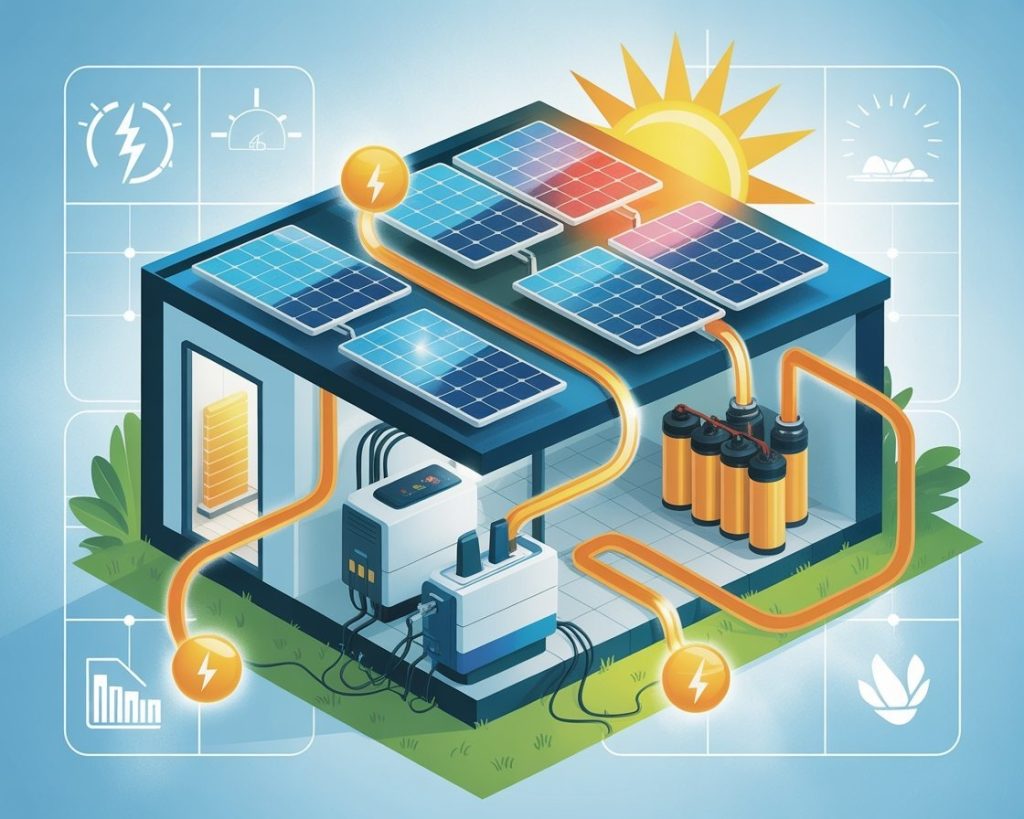
As the world continues its shift toward renewable energy, solar power remains at the forefront of innovation. Across homes, businesses, and industries, solar technology is revolutionising the way we generate, store, and utilise electricity. While solar panels capture sunlight, two critical components ensure that this energy is both usable and reliable: the solar inverter and the solar battery.
Together, they form the backbone of a complete solar energy system, one that converts raw sunlight into stable, accessible electricity while ensuring a continuous power supply, even when the sun isn’t shining.
This article examines how these technologies operate, their advantages, and why their integration is crucial for the future of clean energy.
Understanding the Solar Power Process
A solar energy system consists of three main elements:
- Photovoltaic (PV) Panels: Capture sunlight and convert it into direct current (DC) electricity.
- Solar Inverter: Converts DC into alternating current (AC) for household or industrial use.
- Solar Battery: Stores excess energy for later use, ensuring continuous power availability.
This trio creates a seamless ecosystem of power generation, conversion, and storage, a system designed for both independence and sustainability.
The Role of Solar Inverters
At its core, a solar inverter acts as the brain of the solar power system. It takes the DC electricity generated by solar panels and converts it into AC electricity, the standard form of energy used by most appliances, lighting systems, and industrial machinery.
How Solar Inverters Work
Solar inverters operate using advanced semiconductor circuitry that switches DC power at high speed, producing AC with precise frequency and voltage. Modern models also feature maximum power point tracking (MPPT) technology, which continuously adjusts the inverter’s input to maximise the energy extracted from the solar panels under varying sunlight conditions.
Types of Solar Inverters
- String Inverters: Connect multiple panels in series, ideal for small to medium installations.
- Microinverters: Attached to individual panels for optimised performance and shade tolerance.
- Hybrid Inverters: Combine inverter and charger functionalities, ideal for systems that include batteries.
Advanced solar inverters also monitor energy production, detect faults, and integrate seamlessly with smart home or industrial automation systems, turning solar setups into intelligent, connected energy networks.
The Role of Solar Batteries
While inverters make solar energy usable, batteries make it dependable. A solar battery stores surplus electricity generated during the day for use at night or during cloudy weather. This not only enhances energy self-sufficiency but also stabilises grid performance in hybrid systems.
How Solar Batteries Work
When solar panels produce more power than is immediately needed, the extra electricity is directed to the battery bank. The stored energy is then released back into the system during low-generation periods, ensuring a consistent energy supply.
Types of Solar Batteries
- Lithium-Ion Batteries: Lightweight, efficient, and long-lasting, ideal for residential and commercial systems.
- Lead-Acid Batteries: A traditional and cost-effective option for basic off-grid setups.
- Flow Batteries: Emerging technology offering longer cycles and deep discharge capabilities for industrial use.
Modern lithium-based batteries have advanced energy density and safety features, providing higher capacity, faster charging, and longer operational lifespans than older chemistries.
The Synergy Between Inverters and Batteries
A solar system reaches peak performance when the inverter and battery are properly integrated. The inverter ensures electricity is converted and distributed efficiently, while the battery provides storage and stability.
Here’s how they work in harmony:
- The inverter manages the flow of electricity between the solar panels, battery, and load.
- During peak sunlight, it powers devices directly and charges the battery with surplus energy.
- When solar generation drops, the inverter switches automatically to draw power from the battery.
This seamless coordination guarantees uninterrupted electricity, reducing dependency on the grid and maximising energy independence.
Key Benefits of Integrated Solar Power Systems
1. Energy Independence
By combining inverters and batteries, users can generate, store, and manage their own electricity, reducing reliance on utility providers.
2. Cost Efficiency
Stored energy can be used during high-demand periods, reducing electricity bills. Over time, savings offset the initial investment.
3. Resilience During Outages
In areas prone to blackouts, battery-integrated systems provide backup power to keep essential devices and appliances running.
4. Sustainability
These systems operate without emissions, helping to reduce carbon footprints and align with global climate goals.
5. Scalability
Solar energy systems can be expanded with additional panels, batteries, or inverters as energy needs grow.
6. Smart Energy Management
Modern systems include intelligent monitoring software, enabling users to track energy usage and optimise efficiency in real-time.
Applications Across Sectors
1. Residential Energy Solutions
Homeowners use integrated solar setups for backup power, energy cost savings, and sustainable living. With sleek designs and smart monitoring, these systems fit seamlessly into modern homes.
2. Commercial and Industrial Applications
Businesses leverage solar-plus-storage systems to cut operational costs, meet sustainability mandates, and protect against grid fluctuations. Manufacturing plants, data centres, and logistics facilities benefit particularly from consistent power flow.
3. Remote and Off-Grid Locations
For rural areas, research stations, and island communities, solar inverters and battery systems provide a practical way to achieve full off-grid energy independence.
4. Emergency and Disaster Relief
Portable solar systems equipped with inverters and batteries can supply critical power for communication and healthcare during crises, replacing diesel generators.
Environmental and Economic Impact
Environmental Benefits
- Zero carbon emissions during operation
- Reduced dependency on fossil fuels
- Quiet, pollution-free operation
- Long-term sustainability through renewable resources
Economic Advantages
- Lower energy bills due to self-consumption
- Minimal maintenance costs with durable components
- Extended system lifespan (often 10–15 years or more)
- Increased property and asset value due to energy independence
By combining environmental responsibility with financial practicality, integrated solar inverter and battery systems represent the future of sustainable infrastructure.
Technological Advancements Driving the Future
The solar industry continues to evolve rapidly, with inverters and batteries becoming smarter, safer, and more efficient. Key trends shaping the next generation include:
1. AI and IoT Integration
Artificial intelligence enables predictive maintenance and energy optimisation, while IoT connectivity allows remote monitoring and automated control through cloud-based dashboards.
2. Enhanced Battery Chemistry
Emerging technologies like solid-state batteries promise even greater energy density, safety, and lifespan.
3. Bi-Directional Inverters
These systems allow two-way energy flow, from solar to storage and from battery back to grid, supporting vehicle-to-grid (V2G) and microgrid applications.
4. Modular and Scalable Systems
Future solar setups will allow plug-and-play expansion, enabling users to add new components as energy demands increase.
These innovations will make solar energy systems more flexible, affordable, and accessible across all regions and industries.
Overcoming Challenges
While adoption is accelerating, some challenges remain:
- Initial Investment: High upfront costs can deter users, though prices are dropping steadily.
- Battery Recycling: End-of-life management must improve to minimise environmental impact.
- Component Compatibility: Inverters and batteries must be matched carefully for efficiency and safety.
- Grid Regulations: Policies governing energy storage and feed-in tariffs vary by country, influencing system design and ROI.
Addressing these challenges will ensure widespread adoption and smoother integration into the global energy ecosystem.
The Future of Solar Energy Systems
As governments and corporations commit to carbon neutrality, the synergy of solar inverters and batteries will play a pivotal role in achieving sustainable energy goals.
The next decade will see the rise of smart, decentralised power networks, where homes, businesses, and even vehicles generate and share electricity autonomously. In this future, every building becomes a potential power plant, supported by efficient inverters, long-lasting batteries, and intelligent software management.
This shift not only supports energy security but also empowers individuals and communities to take control of their power needs while contributing to a greener planet.
Conclusion
The integration of the solar inverter and solar battery represents a monumental leap in renewable energy innovation. Together, they transform sunlight into reliable, sustainable, and accessible electricity, powering everything from homes to industries and entire off-grid communities.
As the world moves toward cleaner and smarter energy ecosystems, these two technologies will remain at the heart of progress. By enabling independence, resilience, and efficiency, they ensure that the energy of tomorrow is not just renewable, it’s intelligent, adaptable, and sustainable.
