
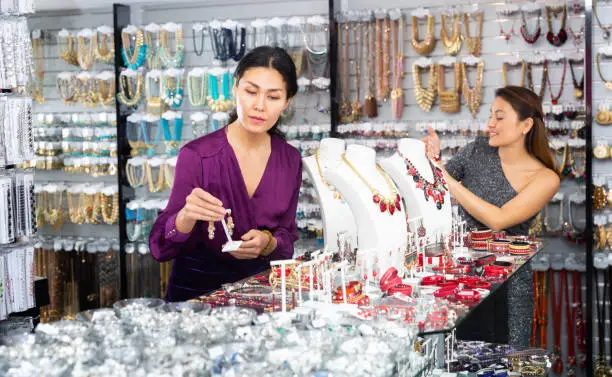
In the worldwide fashion accessory market, costume jewelry companies integrate imagination, artistry, and trade into a winning combination. The burgeoning demand for economical, trendy jewelry has led to increased rivalry among suppliers. This has created both opportunities and difficulties for businesses reliant on dependable costume jewelry manufacturers.
In the case of B2B businesses, such as wholesalers, distributors, and private-label companies, understanding the dynamic and competitive ecosystem is crucial. The choice of manufacturer can shape product quality, brand positioning, supply chain smoothness, and profits, as well as influence the company’s standing for the foreseeable future. Therefore, we seek to demonstrate how businesses can operate in the cutthroat arena of costume jewelry manufacturing, win the desired partners, and achieve a competitive edge in the international marketplace.
The Changing Patterns in the Global Costume Jewelry Industry
Several factors have created an ideal environment for the rapid growth of the global costume jewelry market in recent years. Among the most important are the rise of trending social media, the e-commerce surge, and demand for affordable luxury. Consumers, regardless of location, are in search of stylish, low-priced embellishments that match their fast-evolving personas.
The heightened demand on a global scale has triggered a surge in competition among suppliers. Today’s costume jewelry manufacturers face the challenge of needing to produce jewelry in large quantities and of high standards, while also having to quickly adjust to the increasingly rapid commercial changes regarding trends and compliance. B2B buyers show interest in partnering with suppliers who offer flexibility, innovative designs, and sustainable practices, as opposed to only focusing on the cost.In addition, the broader range of products, including not only earrings and bracelets, but also necklace manufacturers and ring producers, has promoted more intricate practices within the specialty. Certain suppliers direct their focus to large quantity production on a global scale for major retail players, while others serve smaller, more bespoke lines for boutique brands.
Leading manufacturers exhibit the following traits:
- Innovative and Adaptive Design
Manufacturers need to be innovators when it comes to tracking fashion trends on the worldwide market and adapting them to design jewelry that can be sold profitably. Suppliers can use qualified designers and preserve exclusive rights to prototypes made with their CAD (computer aided design).
- Material Knowledge and Quality Service
Brass and stainless steel are low-cost materials that are durable and visually appealing. Manufacturers can help their B2B partners protect their reputations by complying with international safety standards (nickel-free, lead-free, and hypoallergenic).
- Production Adaptability and Scalability
A market that does not have stability results in orders that have a high variance. The ideal supplier can accommodate both larger orders and smaller customized ones, especially when it comes to maintaining the same level of quality for both of them, consistently on time.
- Value of Supply Chain Control
Competitors have different levels of control when it comes to their supply chain, and B2B buyers appreciate it when their suppliers offer visibility to their entire supply chain and offer them predictable lead times while having transparent costs.
- Ethical and Sustainable Processes
The international market is more open to buying products made by manufacturers that are eco-conscious and offer green plating, use recycled materials, and have fair and eco-compliant labor.
Services Provided to Evaluate Global Jewelry Suppliers
For B2B companies starting to operate in new regions or widening their supply chain sourcing, there is a need for strategic supplier evaluation. Finding the right costume jewelry manufacturer requires due diligence, technical evaluations, and management of relationships.
Assessing of Production Capacity
Details on equipment, production volumes, and production capacity need to be provided. Manufacturers who have high investments in moving casting, polishing, and plating equipment.
Assessment of Sample Testing and Certificates
Quality, finish, and durability of product samples ought to be evaluated by the business before contractual engagement of several years. Certificates on meeting and complying global safety standards as well as legally importing and distributing are crucial.
Assess Communication and Responsiveness
Smooth supply chain coordination rests on the communication and responsiveness of the suppliers. Suppliers who are responsive and provide updates on the orders, production timelines, and shipment details of the orders are likely to have stable supply chains.
Assess Overall Value, Not Just Price
Although pricing is a key factor, going with the supplier that offers the lowest pricing is a poor choice in the long run. When comparing suppliers, quality, service, and reliability should matter more than the cost.
For instance, a necklace manufacturer and a bracelet-finished good producer that offer comprehensive service from design to packaging eliminate multiple suppliers, therefore saving significant time and cost to the B2B customer.
Global Trends Affecting the Jewelry Manufacturing Industry
The costume jewelry market is influenced by shifting trends in designing, manufacturing, and worldwide distributing. Trend analysis is needed for B2B businesses to effectively devise their sourcing strategies.
Digitalisation and Intelligent Manufacturing
Firms are increasingly adopting 3D printing, AI-assisted design evaluation, and digital sampling techniques to lower the cost of prototyping and accelerate time to market.
Sustainability and Supply Chain Traceability
More and more businesses are expected to provide a transparent supply chain. Use of biodegradable materials, ethical labor, and recyclable packaging are key selling features in both B2B and B2C.
Regional Style Preferences
Distinct style trends manifest in different areas. For instance, in Europe, a minimalist metallic style takes precedence, whereas in Asia, designs with gemstones are in-demand. Regional design adaptations provide manufacturers with a positional advantage in global competition.
E-commerce-Driven Growth
The growth of online retail and social media has accelerated the speed of the fashion cycle. Manufacturers need to have the ability to smaller, quicker, and more frequent production runs relative to fast-paced retail schedules.
Private Label Expansion
There is a notable preference among B2B clients for private labels due to the opportunity for increased brand equity. Manufacturers are becoming more sought-after collaborators when they provide brand differentiation through customized logos, packaging designed for a product, and exclusive line designs.
Building Long Term Partnerships in a Competitive Market
In a fast-paced and highly populated marketplace, the ability to maintain long-standing partnerships is more valuable than interchangeable supplier relationships. B2B buyers should aim to build relationships based on trust with their costume jewelry manufacturer and collaborate with them in an integrated manner, maintaining transparency and working toward mutual growth.
- Collaborative Product Development
Incorporating manufacturers into the design process at the early stages helps with cost savings, innovation, and quicker time to market.
- Performance-Based Agreements
Clear performance parameters for quality, timeliness in delivery, and communication provide accountability and consistency.
Collaborative forecasting and planning:
Through collaborative forecasting, all parties can know changes in demand, which allows raw material suppliers and manufacturers to better prepare and allocate production, ultimately resulting in shorter lead times and better delivery accuracies.
Continuous improvement and feedback:
Long-term collaborators are able to implement feedback loops that allow for quicker evaluation of product offerings which contributes to improved design, increased durability and overall customer satisfaction.
The synergy of these types of partnerships leads to mutual winners: manufacturers being able to count on demand and B2B brands have the quality and differentiation to stand out in the market.
Conclusion
Understanding the ecosystem of costume jewelry companies and the global market requires the right mix of patience, strategic thinking and understanding the importance of enduring partnerships. The top B2B players are those that have established networks with costume jewelry manufacturers that possess the right mix of quality craftsmanship, innovative technologies and ethical practices.
B2B buyers can design relationships that are not purely transactional, but rather truly collaborative partnerships by understanding how manufacturers work, adopting digital technologies and focusing on sustainability. Whether engaging a necklace manufacturer and design collaborator or a comprehensive supplier, the successful outcome will be determined by the selected partners matching the brand’s objectives, values and international ambitions.
It’s a fast-paced environment with new trends launching on a regular basis. In the global costume jewelry market, innovative and reliable partnerships with manufacturers are crucial for long-term success.
