
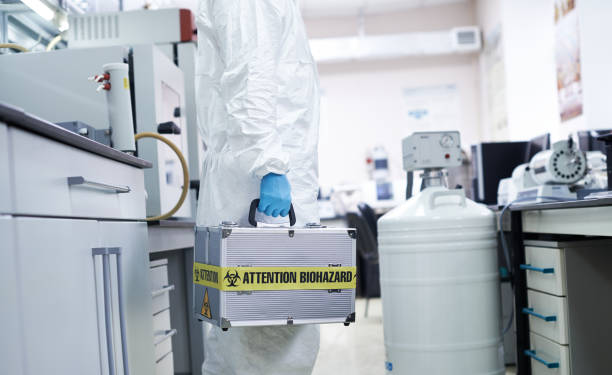
Biological compounds are unforgiving. In contrast to common reagents, peptides and proteins can be destroyed by one instance of negligent storage, incorrect temperature, wrong diluent, a vial left uncovered for too long. The following five rules are in place because sample integrity and scientist safety are not separate issues. They go down together.
Protocol 1: Surface and Septum Sanitization
First, wipe every surface of your work area with 70% isopropyl alcohol. Do the same with the vial septum before each and every needle insertion, the rubber stopper is porous enough that a single cell of bacteria can contaminate a whole vial of solution. Swab, wait 30 seconds, then use it.
Your laminar flow hood (and since you don’t have a proper clean room and full bunny suit, you must be working with one of these) will have HEPA filtration and keep positive air pressure on your work. Use it for high-purity work if you have it. If you don’t have one, at least assure that the area is relatively free of foot traffic and any disturbing air currents before opening a vial.
Protocol 2: Diluent Selection For Reconstitution
In essence, lyophilized peptides must be reconstituted with an appropriate diluent in order to reach their liquid state for injection. Errors in reconstitution are insidious because the solution appears viable; however, the wrong selection for reconstitution may promote rapid microbial proliferation.
Sterile water is the correct reconstitution liquid for single-dose situations. However, if a multiple-dose vial is being used where there will be multiple extraction periods from the vial, a diluent containing preservative is required. Bacteriostatic water is the proper solution and contains benzyl alcohol, which inhibits the proliferation of bacteria in between separate extractions from the same vial. If this is not used, each needle puncture has the potential for a significant increase in microbial contamination.
Protocol 3: Mechanical Stress During Reconstitution
Shaking a vial of reconstituted peptide isn’t aggressive, it’s destructive. The mechanical shear force from vigorous agitation can physically break peptide chains, reducing both potency and stability before the compound has even been used.
The correct method: insert the needle, allow the vial’s vacuum to draw the liquid in slowly, and once reconstituted, swirl gently in a circular motion to mix. If there’s no vacuum draw, introduce the liquid against the glass wall rather than directly onto the lyophilized cake. The goal is dissolution without friction.
Patience here directly affects compound quality. There’s no recovery from shear degradation. Once those bonds are broken, they stay broken.
Protocol 4: Temperature Logging and Freeze-Thaw Prevention
One of the most risks that are usually underestimated when handling peptides is thermal lability. As most biologically active compounds, they should be kept between 2 and 8 degrees Celcius, cold enough that they don’t degrade but not so cold that they freeze. It’s not the freeze event that harms the peptide; it’s the subsequent thaw event. For water-based solutions, as temperature drops, water will begin to crystallize. As temperature rises, the crystals will melt, and reform as smaller crystals. These smaller crystals physically tear the molecular structure.
The best way to ensure that your sample isn’t degrading because of freeze-thaw cycles is to keep a log of how many the sample has been through. The general rule of thumb in biotech is that any sample that has been frozen and thawed more than twice is of questionable integrity. And even if you know it’s been frozen and/or thawed twice and everything’s been alright, that doesn’t mean nothing is happening. Everything’s activity has been decreasing; any reaction you are running with it will have lower yield. It may not be bad, but it’s not the same as if it was fresh. Light exposure is another cause of slow degradation; hence why amber vials and opaque storage containers were created.
Aliquoting to Reduce Thermal Stress
The easiest way to cut the number of freeze/thaw cycles that a reconstituted compound is exposed to, after that first one, is to divide the compound solution into several single-use aliquots, and freeze all but one immediately. This does mean that you will have to have more containers and do some more up-front preparation when creating the sample, but it protects the integrity of your entire batch. In fact, it is better to freeze the sample in small enough aliquots that the entire water portion of the aliquot freezes instantaneously. This ensures a repeatable thermal cycle, which reduces thermal stress.
Protocol 5: Inventory Management and Sharps Handling
A FIFO – First In, First Out system isn’t just about efficiency. It’s a safety structure. Every vial gets labeled with the date it was opened, not just the date of manufacture. Once a multi-dose vial passes its safe use window, it doesn’t get finished to avoid waste. It gets discarded.
Sharps disposal follows its own non-negotiable path. Used needles go directly into a puncture-resistant sharps container immediately after use. They don’t get recapped manually, they don’t sit on a bench surface, and they don’t go into general waste. This protects the people handling waste downstream, not just the person in the lab.
PPE, nitrile gloves, lab coat, eye protection, stays on for the full duration of the session. Removing a glove to answer a phone and then returning without re-gloving is a contamination event.
Handling biological compounds well is mostly about building habits that don’t have exceptions. The protocols that fail are the ones treated as guidelines rather than standards. The five above cover the highest-risk points in a typical session, sanitization, diluent choice, reconstitution method, temperature control, and waste handling. Get those right consistently and you’ve removed most of the variables that cause samples to fail.
