
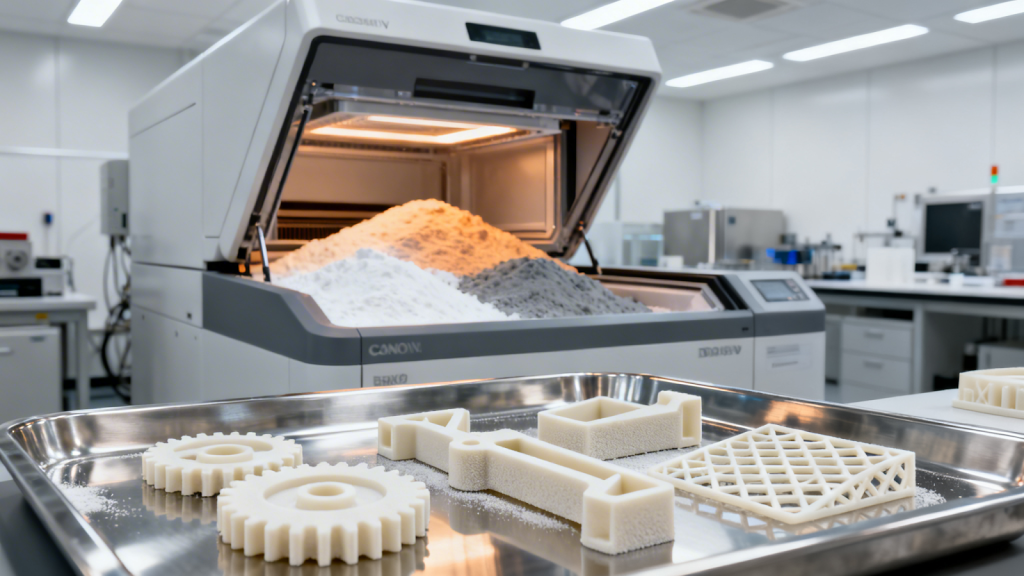
Selective Laser Sintering (SLS) is widely recognized for producing strong and durable polymer components without the need for traditional molds, tooling, or extensive post-processing. This powder bed fusion process uses a high powered laser to selectively fuse nylon particles layer by layer, building parts directly from a digital design. Each layer solidifies precisely where the laser passes, forming highly functional components that are ready for industrial use.
Unlike conventional fabrication methods such as injection molding or CNC machining, SLS allows engineers and designers to work without worrying about support structures or complex assembly constraints. Complex shapes, internal channels, and intricate features can be created in a single build, offering unprecedented design freedom.
How the Process Enhances Mechanical Strength
In SLS 3D printing, the unsintered powder surrounding the part acts as a natural support, which eliminates the need for temporary scaffolding. This allows engineers to build geometrically complex components including lattice structures, internal cavities, snap fit features, and overhangs all in a single production cycle.
The thermal bonding process fuses the nylon particles together at the molecular level, resulting in excellent interlayer adhesion. The finished parts exhibit strong tensile strength, impact resistance, and fatigue endurance. Nylon materials used in SLS, such as PA12 and PA11, are known for their flexibility, durability, and resistance to heat and wear, making them suitable for load bearing applications, functional prototypes, and even small production runs.
Industrial Applications and Use Cases
SLS produced parts are widely used across multiple industries. Automotive manufacturers utilize SLS for housings, ducts, brackets, and functional covers. Electronics companies employ it to create enclosures and assemblies with integrated cable channels. Machine shops and tooling companies rely on SLS for functional brackets, jigs, and fixtures that can endure operational stress.
Many businesses prefer this approach for advanced nylon prototyping solutions because it supports rapid iteration and small batch production without requiring changes in tooling or equipment. The ability to nest multiple components in a single build chamber further improves cost efficiency and reduces production lead times.
Why Manufacturers Choose SLS
SLS provides several advantages over traditional manufacturing. It reduces material waste because only the necessary powder is fused, and the unused powder can often be recycled. Tooling costs are eliminated, making the process cost effective for low-volume production. Development cycles are shortened since digital designs can be directly converted into functional parts without intermediate steps.
For companies seeking durable polymer components that perform reliably under mechanical stress, SLS bridges the gap between prototype validation and end use production. Its combination of strength, flexibility, and design freedom makes it a trusted choice in industrial additive manufacturing.
FAQs
What materials are commonly used in SLS technology?
Nylon based powders such as PA12 and PA11 are most commonly used due to their strength, flexibility, and heat resistance.
Are SLS parts suitable for end use applications?
Yes, many SLS parts are strong enough for functional and load bearing industrial applications.
Does SLS require support structures?
No, the surrounding unsintered powder supports the part during the build process, allowing complex geometries without additional supports.
For more information on 3D printing projects, visit KAD 3D.
